Start with a recognizable silhouette
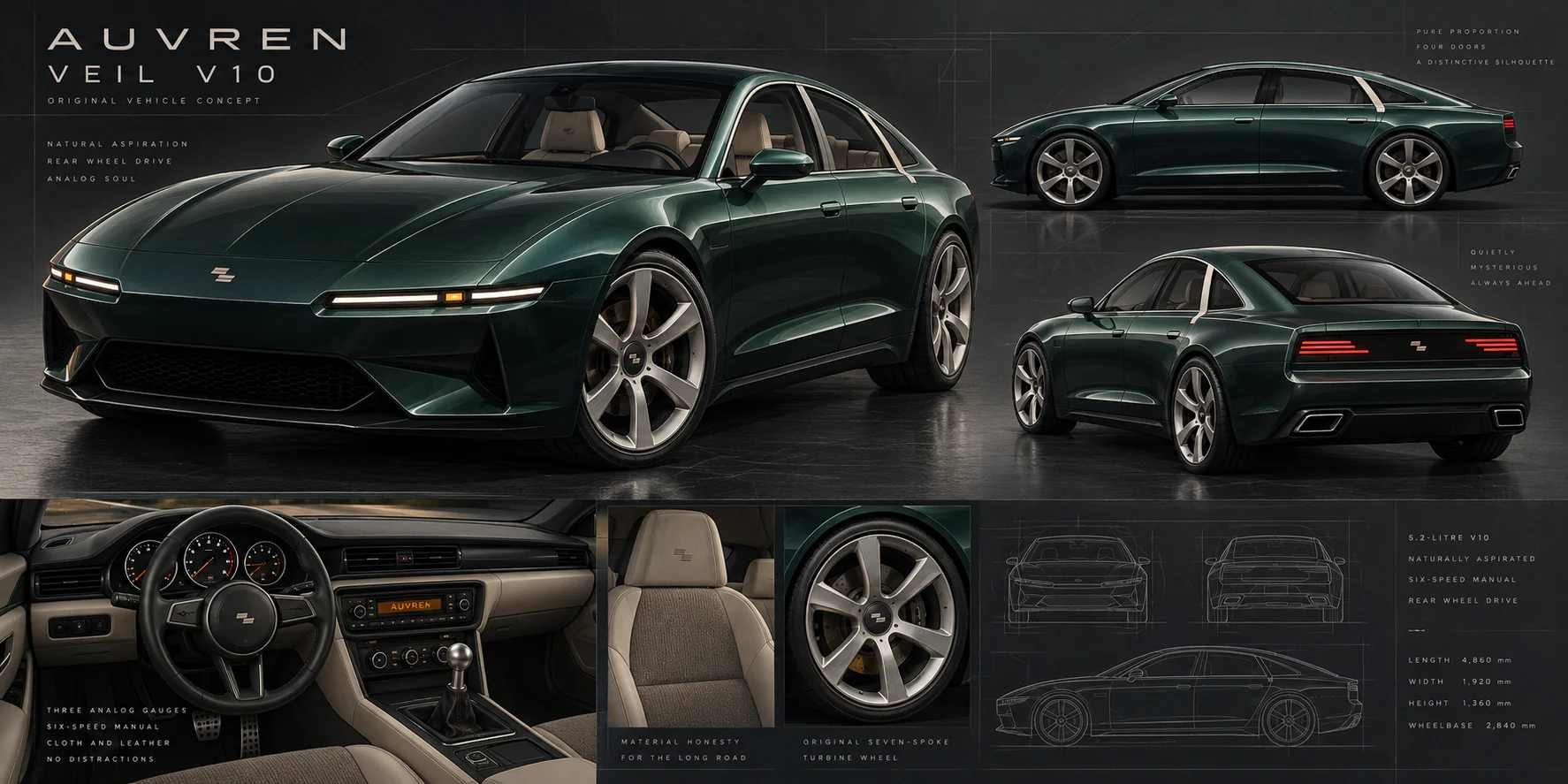
The Auvren brief calls for a long nose, a short rear deck, clear shoulders, and a fastback roof. Those relationships matter before a small grille detail or material finish. If the basic volumes do not agree across the views, details will not resolve the difference.
Use references as references
The project’s exterior sheet brings side, top, front, and rear views into the same conversation. Its detail sheet considers bodywork, wheels, and the analog cabin. They are AI-generated visual guides, not measured engineering drawings.
When a generated view disagrees with the original design, it raises a modeling question. It does not automatically redefine the car.
Build for the intended experience
A car seen only in a distant render has different demands from one explored in a game. Camera distance, reflections, the relationship between glass and cabin, and the edges around a door all affect where the work needs to go.
For this project, the latest checkpoint describes a static model in a visual-review scene. That makes evaluating shape and materials a concrete step, while driving and interactive doors remain separate implementation work in that scene.
Show the stage honestly
The lab labels concept artwork, modeling references, and actual prototype screenshots separately. This helps visitors see both the direction and the distance still to travel.
A finished-looking concept image is not proof that the 3D asset is complete. The most useful next image is one that shows what the model actually looks like, and what changed.
These design notes draw on the original Auvren design brief and the published modeling checkpoint. They describe the approach, not a new completed modeling milestone.